-
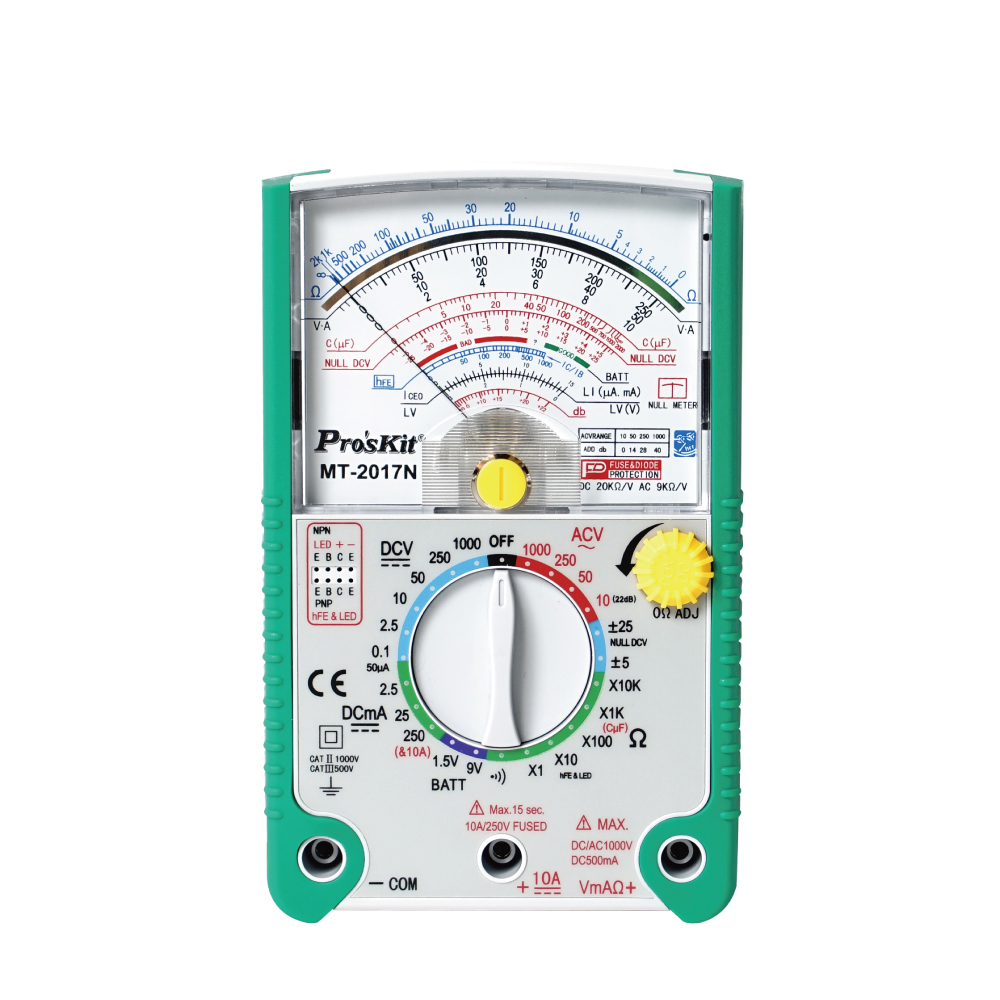
MT-2017N HOW TO USE?
-
What is the MT-2017N, and what is it primarily used for?
The MT-2017N is a 26-range analog multimeter with misuse protection. It measures AC/DC voltage, DC current, and resistance and provides reference tests for batteries, diodes, transistors, LEDs, continuity, and capacitance.
-
Which users or work situations is the MT-2017N suitable for?
It is suitable for electronics training, repair technicians, and users who need to observe trends in pointer movement. An analog meter shows adjustment, fluctuation, and continuous change intuitively, but range and scale interpretation require practice.
-
What are the features and benefits of full-range overload protection on the MT-2017N?
Misuse and overload protection reduce the risk of damage from an incorrect range, but they do not permit ignoring ratings or making arbitrary incorrect connections. Confirm the switch position, test-lead jacks, and circuit before measurement.
-
What are the features and benefits of the center-zero and component-test functions on the MT-2017N?
The center-zero range shows positive and negative DC changes, while built-in sockets support tests of components such as transistors and LEDs. These functions are useful for training and basic troubleshooting.
-
Why is mechanical zero adjustment required before using the MT-2017N?
Place the meter horizontally with no signal connected and confirm that the pointer rests at the left zero mark. If necessary, adjust it with the mechanical zero screw. For resistance ranges, short the probes and perform the zero-ohm adjustment separately.
-
What are the maximum ranges of the MT-2017N?
Official information lists AC and DC voltage up to 1000 V, DC current up to 10 A, resistance up to 20 MΩ, and a 2000 µF reference capacitance test. Actual operation must follow the corresponding range and time limits.
-
What precautions apply when measuring high voltage or 10 A current with the MT-2017N?
Confirm that the test leads, jacks, and range are completely correct before measurement. The 10 A range is intended only for the short duration specified in the manual. High-voltage work requires approved protection and qualified personnel.
-
What should I do if the MT-2017N pointer does not return to zero or readings are unstable?
Check mechanical zero, battery condition, test-lead contact, and range selection, and inspect the housing for impact damage. If the pointer sticks, the movement is abnormal, or a fuse is damaged, stop using the meter and have it serviced.
-
How do the advantages and disadvantages of the MT-2017N compare with a digital multimeter?
An analog meter is useful for observing continuous changes and adjustment trends, while a digital meter provides direct readings and generally higher resolution. Repair and training work can select either according to signal characteristics; neither fully replaces the other.
-
Which accessories and version information should be confirmed before purchasing the MT-2017N?
Confirm the complete model number, test leads, battery requirements, manual, and market certifications. For high-energy power-distribution work, also confirm that the safety category suits the site rather than relying only on the maximum voltage value.